Friday, July 4, 2008

Leech Neurophysiology LAB (Unit Three)


This lab simulation showed how to collect data from nerve activity using a leech.


The first image below shows the micro-manipulator used in the lab with the oscillope trace.


The next image below shows the shape of a sensory neuron with the aid of ultra-light and dye.


1. What is the electrode measuring? Electrodes record the activity of neurons. (An electrode is what someone uses to deliver a "shock" to a patient also). An electrode can be defined as a conductor to establish electrical contact with a nonmetallic substance.


2. Why use leeches in neurophysiology experiments? For this particular experiment we are using a leech because they have a simple neurological structure. This will make the structure easier to understand than that of a more complexly structured organism. Simple nervous systems follow many of the same rules that complex nervous structures follow. Therefore, understanding the simple structures first, will assist in understanding the complex structures like the human brain. Also, people generally don't feel sorry about using leeches for experiments.


3. What is the difference between a sensory and a motor neuron? A sensory neuron takes messages from a sensory receptor to the central nervous system. A motor neuron takes nerve pulses away from the central nervous system.


4. Do you think a leech experiences pain? What is pain? For the purposes of this lab, no the leech did not experience pain. (This was the intention of initially using the ethanol solution as an anesthetic). In general, however, leeches probably experience pain because they have so many neurons to send the "pain" signal to the central nervous system. Pain is initially felt in the nerves and then processed in the brain.


5. What were the two most interesting things about doing this lab? I found it interesting to be able to engage in a computerized dissection--that's a format I have not experienced before and is kind of a catch-all for avoiding errors. Also, I found the lab a lot more interesting once the dye had been applied to the cell and the detail and appearance of the cell changed.


6. Anything you found confusing or didn't like about the lab? I may have to take another Microbiology class in real life, because while the computer is convenient, I have the desire to actually take part (physically) in labs of this nature.

Thursday, June 26, 2008

Self and Unit Evaluation; Unit Two

REGARDING YOUR OWN PERFORMANCE
1. What were the three aspects of the assignments I've submitted that I am most proud of?


I am most proud of the images submitted with the unit lab project, my personal investment in a blood pressure monitor, and the inclusion of the Tim Russert correlation with my compendium. I enjoyed this unit, with its real-life application (s).

2. What two aspects of my submitted assignments do I believe could have used some improvement?

In the unit lab I had a hard time (again) with several of the images. I can not figure out how to have the graphed images appear larger when they're clicked upon. I didn't want to spend much more time with the technology as it seems frivolous and just frustrates me. (Perhaps I should take my metabolic measurements using that as an activity?!) Also, sometimes I have difficulty putting things in my own words. When phrases are written out in the text describing the function or one thing or another I tend to think the author did a good enough job and just want to copy and paste everything instead of rewording it.


3. What do I believe my overall grade should be for this unit? I believe I should get an A on this unit.


4. How could I perform better in the next unit? Next unit I'd like to spend more time completing the chapters, web activities, etc. before submitting work. I find that I like to feel accomplished so I go through the assignments in the most random order to get things off the checklist. I have a good understanding when I'm through with everything, but logically would be benefited by slowing down. (I'm not traveling over the next couple of weeks so this will be much easier).


REGARDING THE UNIT (adapted from Stephen Brookfield, University of St. Thomas "Critical Incident Questionnaire")
At what moment during this unit did you feel most engaged with the course?

I felt most engaged during the unit lab. I had a friend with me so that contributed. I found that later in the day she and I would do something or encounter someone and be like, "I wonder what THAT would do to your blood pressure?!" I found the activity to be engaging in the moment of the lab, but continuously engaging as well.

At what moment unit did you feel most distanced from the course?

I felt really distanced from the course towards the beginning of last week. I traveled from AZ to New Mexico, Texas, Maryland, Pennsylvania, and New Jersey to catch up with some friends and family. My computer wasn't always cooperative so I found myself coveting internet time to finish everything.

What action that anyone (teacher or student) took during this unit did you find most puzzling or confusing?

I wasn't puzzled or confused by anything in this unit. (Or at least not an action that was taken by anyone).

What about this unit surprised you the most?
I was surprised by how relevant the unit was. A lot of the information was repetitive from past classes, general knowledge, etc, but I learned useful things that I plan to incorporate into my daily life, including the use of a blood pressure monitor. I was surprised how "into" this unit I was.

Unit Two Lab Project: Exercise Physiology

Muscles under physical activity are the biggest users of oxygen. The body needs oxygen for ceullar respiration to occur. During exercise more muscles are needed so the heart is forced to pump faster. The pulse is the measurement of how fast the heart is pumping. The blood pressure measures the force of blood against the vessel wall. Systolic pressure is the highest point--blood is being forced out by the contraction of the heart muscle. Diastolic pressure is the lowest point--between heart beats when the heart is inactive. (reference: Topic One Powerpoint).


I found this lab to be entertaining. I had planned to go hiking with a friend this week and brought a blood pressure monitor along the trek. Image one and two show me taking my blood pressure and pulse. The remaining images show the three activities I chose to monitor: walking, yoga, and eating.


The purpose of the exercise physiology lab was to calculate three average metabolic measures: pulse, respiration rate, and blood pressure. I first found the average metabolic measures at rest (baseline activity). I then took part in several activities to monitor the effect each had on the measurements.

Prior to each activity I formed a hypothesis regarding the effect the activity would have on the three metabolic measures. I thought that walking would increase my pulse and respiration rate, while decreasing my blood pressure. I proposed that yoga would decrease all of the metabolic measures. Lastly, I presumed that eating would not effect my pulse or respiration rate, but may increase my blood pressure.

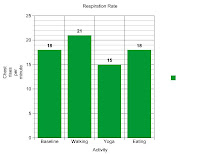
The following chart shows the measured results. Each activity was done in a three part series, shown by the different colored markers. The average measure for each activity is then printed in red ink.


Below are bar graphs that compare and contrast each measurement.


The above data shows, that for the most part, my original hypothese were correct. Walking increased my pulse and respiration rate. Walking also increased my blood pressure. Yoga did indeed decrease all of the metabolic measurements. Lastly, eating had very little effect on any of the measurements. My pulse increased slightly immediately following food intake, but the other measurements remained as steady as during baseline activity.

I didn't have any problems with the measurements. I had a manual blood pressure monitor of my own so that allowed an ease in completing the assignment and taking measurements immediately following each activity. Most activities seem to effect metabolic rate to some degree. Naturally, the more intsense an activity, the more dramatic of an effect it has on the metabolic measurements. The more strenuous an activity, the more oxygen the body needs.

Wednesday, June 18, 2008

Unit Two Ethical Issues Essay

For a ten month period I lived on a small island in the South Pacific. During that time I gardened and ate an organic diet. I participated in many community meal gatherings and found myself entirely satisfied with life. I attribute much of this to my nourishing lifestyle habits. It is tradition in the South Pacific to share meals with neighbors, passing full plates back and forth between homes and families. If you are presented a plate of food, after its consumption, you hold onto the plate. Whenever the mood strikes you, you return the plate to its owner--full. This tradition (never ending!) leaves one feeling both physically and emotionally fulfilled.

Those in support of the "Slow Food Movement" further encourage this sense of a food community. The process of slowing down and making homemade meals is equal parts spiritually and nutritionally satisfying. Aside from food preparation, food selection could be slowed down as well. Taking time to garden and cultivate ones own ingredients is incredibly rewarding--even therapeutic. Slowing down to hand-squeeze orange juice or hand-squeeze milk from coconuts is commonplace in areas less developed than the United States.

The author of the "Unhappy Meals" article seems to agree with this concept, saying once food was all that you could eat. Now you can choose from many foodlike substances. The consumption of whole foods versus processed foods is very much recommended. This can be achieved through gardening, or through being conscious when grocery shopping. Many foods that are advertised as health foods are truly unhealthy. Shopping at a farmer's market and buying fresh organic products is a good way to ensure that your groceries are nourishing.

Buying local food is a widely popular concept. This supports local economies. Also, it contributes to product freshness. There are several organizations creating programs where a local school garden is used for the cafeteria meals. Again, this is the norm for many developing areas, particularly in the South Pacific. Adopting lifestyle changes in shopping and cooking habits could certainly contribute to a more physically and emotionally satisfying sense of nourishment for Americans.

Compendium Four (Part Two, Unit Two)

Major Topic Two: Nutrition

Chapter Eight

Glucose and Diffusion--diabetes (Powerpoint Presentation)
Digestion(pages 144-150)
Nutrition and Diet (page 166)
Food (Powerpoint Presentation)


Glucose and Diffusion

Glucose and diffusion deliver nutrients to cells. Glucose is the main chemical burned or combined with oxygen in cellular respiration.

We all need energy to function. We get this energy from the foods we eat. The most efficient way for cells to harvest energy stored in food is through cellular respiration, a pathway for the production of adenosine triphosphate (ATP). ATP, a high energy molecule, is expended by working cells. Cellular respiration has three main stages: glycolysis, the citric acid cycle, and electron transport.

Glycolysis literally means "splitting sugars." Glucose, a six carbon sugar, is split into two molecules of a three carbon sugar. In the process, two molecules of ATP and two "high energy" electron carrying molecules are produced. Glycolysis can occur with or without oxygen. In the presence of oxygen, glycolysis is the first stage of cellular respiration. Without oxygen, glycolysis allows cells to make small amounts of ATP. This process is called fermentation.

The Citric Acid Cycle The Citric Acid Cycle or Krebs Cycle begins after the two molecules of the three carbon sugar produced in glycolysis are converted to a slightly different compound (acetyl CoA). Through a series of intermediate steps, several compounds capable of storing "high energy" electrons are produced along with two ATP molecules. These compounds, known as nicotinamide adenine dinucleotide (NAD) and flavin adenine dinucleotide (FAD), are reduced in the process. These reduced forms carry the "high energy" electrons to the next stage. The Citric Acid Cycle occurs only when oxygen is present but it doesn't use oxygen directly. (http://biology.about.com/library/weekly/aa090601a.htm).


Glucose diffuses through a special protein pore on the cell membrane. Insulin is a protein that is secreted by the pancreas into the bloodstream (normally post-meal). Insulin stimulates cells to use glucose in cellular metabolism or to store it in the liver and muscle.


Type I diabetes occurs when no insulin is produced by the pancreas.


Type II diabetes is directly associated with obesity. The cells become resistant to insulin and can't use glucose.


This image shows the regulation of glucose. The image can be found at the following site, which also includes extensive information relating to Type I and Type II diabetes: http://www.scienceinschool.org/2006/issue1/diabetes/


http://www.cdc.gov/diabetes/ This is a great site put together by the Center for Disease Control. It has patient resources, and also resources for healthcare professionals.


Digestion

The organs of the digestive system are located in the GI tract. Digestion requires ingestion, digestion, movement, absorption, and elimination. All parts of the GI tract have four layers: mucosa, submucosa, muscularis and serosa.


This image shows the process of digestion.


Digestion begins in the mouth. The teeth, saliva, and tongue are each part of the process. The espophogus moves food to the stomach.

The stomach expands to store food. It also mixes food with acidic gastric juices. (The juice is made up of pepsin--an enzyme that digests protein).

The small intestine receives bile from the liver and pancreatic juice from the pancreas. Intestinal enzymes complete the cycle of chemical digestion.

Accesory Organs The accessory organs send secretions to the duodenum (first 25 cm of small intestine).

A. The Pancreas produces pancreatic juice with digestive enzymes for carbohydrates, protein, and fat

B. The Liver produces bile, destroys old blood cells, detoxifies blood, stores iron, makes plasma proteins, stores glucose (as glycogen), breaks down glycogen to glucose, produces urea and helps regulate blood cholesterol levels.

C. The Gallbladder stores bile which is produced by the liver.


The Large Intestine is made up of the cecum, the colon, and rectum. The large intestine absorbs water, salts, and some vitamins; forms the feces; and carries out defecation.
Disorders of the large intestine: diverticulosis, irritable bowel syndrome, inflammatory bowel disease, polyps, and cancer.


Nutrition and Diet

Nutrients released by the digestive process should provide us with plenty of energy, essential amino acids and fatty acids, and all necessary vitamins and minerals. Obesity is increasing rapidly, likely as a result of people's poor eating habits. Obesity is associated with diabetes type two and cardiovascular disease.


The food guide pyramid to the left shows foods to minimize and foods to emphasize for balanced health.


-Proteins supply essential amino acids

-Carbohydrates are necessary, but simple sugars and refined starches cause a rapid release of insulin that can lead to diabetes type two

-Unsaturated fatty acids (omega three in particular) are protective against cardiovascular disease

-Saturated fatty acids lead to plaque (blocking of blood vessels)


Food


The United States has lost much of the cultural and spiritual base to its diet. This has resulted in a dramatic increase in obesity and a decline in overall long term health. The manufacturing process of foods also threatens the farming and agricultural ecosystems.


A large amount of packaged food is sold in the United States each day. To the left is an aerial shot of a typical supermarket. (www.wikipedia.com).
According to this site; http://www.acc.org/advocacy/advoc_issues/summary_obesity.htm, nearly 1,200 deaths each day are attributed to poor lifestyle habits such as nutrition.


Monday, June 16, 2008

Food Nutrition Lab: Nutrition Calculator


This screen shows a nutritional summary of the food that I have eaten today. (Disclaimer: I'm visiting my mother and am indulging in whatever I'd like for the week!).


How healthy a daily diet do you think this is? Why?

I think as a daily diet this diet is ridiculous and unhealthy. While the calorie content is low, the fat content is quite high. Roughly 1500 calories were consumed for the day. Of those calories, 470 (52 g) of those were fat. The amount of saturated fat (22 g) consumed was higher than it should be for an average day. The sodium consumption was high also.

What would you change about this day's eating, if anything? I would have a bit of self control! I'd include more greens in the day's diet--perhaps replace the ice cream sundae with a salad. Also, I'd drink water instead of tea and lemonade. I generally feel parched if I drink liquids other than water through the day. I would consume more calories, but less fat so I would be more satisfied at the end of the day.

Do you find this kind of nutritional tracking helpful? Why or why not? I do find this kind of tracking helpful. I tend to overeat, so tracking everything for the day helps me stay accountable and see that the small handfuls of junk here and there really add up each day. I find it beneficial to know where I'm lacking in vitamins, proteins, fibers, etc. I haven't used this system on a regular basis, but think if I started it would be helpful in balancing my eating habits.

Compendium Three (Unit Two, Part One)

(Chapters 5,6,7)


Cardiovascular System (pages 86-102)
Blood, Cellular Respiration, and Oxygen
(Powerpoint, pages 105-118, Sickle Cell Anemia Case Study site)
Immunity and Microbes (pages 121-140)

____________________________________________________________________

Cardiovascular System and Blood

The cardiovascular system includes the heart and blood vessels. The heart pumps blood and blood vessels move blood to and from the capillaries. The cappillaries are where the exchange of nutrients for waste takes place with tissue cells. Blood is refreshed at the lungs , where gas exchange occurs, at the digestive tract, where nutrients enter the blood, and the kidney, where wastes are removed from the blood. (page 102)

A. Blood Vessels

1. Arteries (and arterioles)
a. take blood away from the heart
b. have thick walls to withstand blood pressure

2. Capillaries

3. Veins (and venules)

a. take blood to the heart
b. relatively weak walls with valves to keep blood flowing in one direction


The heart has a right and left side--each containing an atrium and ventricle. The right side pumps blood through the lungs. It also receives blood from all veins in the body. While blood circulates through the left side of the body, the left side delivers oxygen and nutrients to tissue through the arteries and picks up carbon dioxide through the veins. Valves keep the blood flow in the correct direction. (http://www.learnaboutbypass.com/hrtchmbrs.gif)

B. Features of the Cardiovascular System

1. Pulse-pulse rate indicates the heartbeat rate

2. Blood Pressure- moves blood in arteries (the beating of the heart = flow of blood)

3. Capillary Blood Flow- slow to aid in exchange of nutrients and wastes in the tissues

4. Venous Blood Flow- returns blood to the heart (caused by skeletal muscle contraction, valves, and respiratory movements)

C. Cardiovascular Circuits

1. Pulmonary- blood travels to and from lungs (exchange of gases)

2. Systemic - aorta divides into blood vessels that serve body's organs and cells (exchange with tissue fluid)

Both systems are shown in the diagram to the left. Also, more extensive information regarding each can be viewed at the following website: Pulmonary and Systemic Circulation


Cappilary exchange is explained in detail in the next YouTube video series.


Cardiovascular disease is the leading cause of death in Western countries.
Hypertension and atheroscelerosis can lead to stroke, heart attack, or aneurysm.

Following a healthy diet, exercising, and not smoking help prevent cardiovascular disease.

Atheroscelerosis is an accumulation of soft masses of fatty materials (including cholesterol) beneath the inner linings of arteries. These deposits are called plaque.

Recently, Tim Russet from NBC's Meet the Press died from ruptured cholesterol plaque.

Blood, Cellular Respiration, and Oxygen

Cells need oxygen for cellular respiration to occur. Cellular respiration breaks down glucose to create ATPs for use during cell metabolic reactions. A detailed explanation of the process can be found at the following site: http://biology.clc.uc.edu/Courses/bio104/cellresp.htm
Be sure to check out the song at the top of the page!

Blood

Functions help maintain homeostasis
1. transports hormones, oxygen, nutrients to cells
2. transports carbon dioxide and other wastes from cells
3. fights infections and has various regulatory duties
4. maintains blood pressure
5. regulates body temperature
6. keeps pH of body fluids within normal limits

Components
A. Formed Elements

1. Red Blood Cells (transport of oxygen)

2. White Blood Cells (defense against disease)

3. Platelets (blood clotting)


When an injury causes a blood vessel wall to break, platelets are activated. They change shape from round to spiny, stick to the broken vessel wall and each other, and begin to plug the break. They also interact with other blood proteins to form fibrin. Fibrin strands form a net that entraps more platelets and blood cells, producing a clot that plugs the break. (web source)


B. Plasma
1. 91% of plasma is water
2. plasma proteins are mostly produced by the liver
3. plasma proteins maintain osmotic pressure, regulate pH, and transport molecules

Determining blood type is necessary for transfusions so agglutination (or clumping) of red blood cells does not happen.


Sickle Cell Anemia

Sickled cells lead to the malfunction of several systems (liver, lungs, kidneys), and usually result in early death. Other symptoms of sickle cell anemia include shortness of breath and poor tissue development. Normal red blood cells have a concave shape on both sides, along with high oxygen concentration. A sickled cell has low oxygen conentration and changes shape into what is refered to as sickled. The image below shows normal red blood cells to the left, and a sickled cell to the right. The bizarre shape of sickled cells prevents blood from delivering the necessary oxygen and nutrients.


(http://www.nslc.wustl.edu/sicklecell/part1/background.html)


Hemoglobin is responsible for transporting oxygen from the lungs to the rest of the body. If this transport does not occur, as in the case of sickle cell anemia, the consequence is carbon dioxide and waste build-up.


Immunity and Microbes


Microbes include bacteria and viruses. These perform services of value, but also cause disease. Bacteria cause disease by multiplying in hosts and producing toxins. Viruses take over the host in order to reproduce and can cause new diseases in the process that the human body has a hard time fighting.


Immunity is the ability to fight diseases and cancer and includes lines of defense. There are two types of defenses; nonspecific and specific.


A. Nonspecific Defenses


1. Barriers to Entry


a. skin and mucous membranes
b. chemical bacterias (lysozyme in perspiration, syliva, and tears, also stomach acid)
c. resident bacteria (normal flora)


2. Inflammatory Reaction (involves phagoctyic, neutrophils and macrophages)


3. Protective Proteins


B. Specific Defenses


1. B Cells and Antibody-Mediated Immunity


a. produced and matured in bone marrow
b. directly recognize antigen (molecules that are foreign to the body) and undergo clonal selection
c. Clonal expansion results in antibody-secreting plasma cells and memory B cells


2. T Cells and Cell-Mediated Immunity


a. Cell-mediated immunity against virus-infected cells and cancer cells
b. produced in bone marrow, mature in thymus (gland underneath top of breastbone)
c. secrete cytokines (chemicals that enhance response of all types of immune cells) for control


Aquired Immunity


1. Long lived/active immunity can be induced by vaccines


2. Short lived/passive immunity is needed when a person is dealing with infectious disease


AIDS (Aquired Immune Deficiency Syndrome)


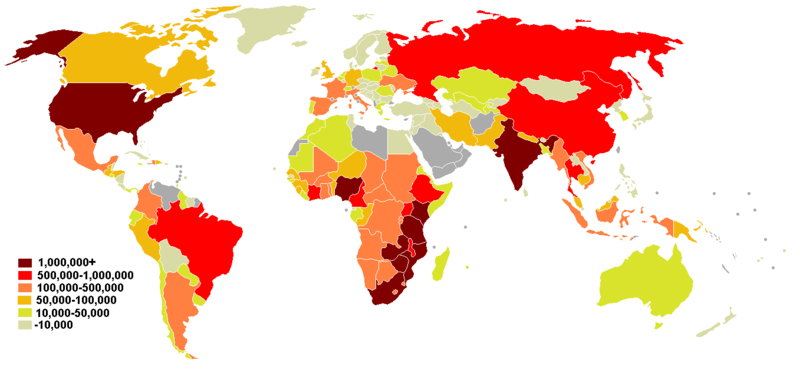
AIDS is caused by HIV (Human Immunodeficiency Virus). The condition reduces the function of the immune system and leaves people unable to fight off infections or tumors. Treatment can slow down the disease, but at this point there is no known cure for AIDS. Medicine is not always available in highly affected areas, such as Africa, where HIV is suspect to have originated.


< This world map shows the amount of people living with AIDS per country as of 2008. (source: wikipedia.com)


Being HIV-positive, or having HIV disease, is not the same as having AIDS. Many people are HIV-positive but don't get sick for many years. As HIV disease continues, it slowly wears down the immune system. Viruses, parasites, fungi and bacteria that usually don't cause any problems can make you very sick if your immune system is damaged. (http://www.aids.org/factSheets/101-what-is-aids.html)

This website contains detailed information and links to numerous fact sheets with statistics on AIDS.